what is a lab manual

What is a Lab Manual? A Comprehensive Guide
Lab manuals are essential guides offering detailed instructions for experiments, ensuring safety and effectiveness in labs, be they educational or research focused.
These documents, sometimes called test guides or user worksheets, direct users through interface exploration with minimal prior software knowledge.
A lab manual clarifies laboratory procedures, protocols, and proper conduct, familiarizing users with facilities, equipment, and measurement tools.
Definition of a Lab Manual
A lab manual is fundamentally a comprehensive, meticulously crafted document designed to serve as a practical guide within laboratory environments. It’s more than just a collection of instructions; it’s a detailed roadmap for conducting experiments safely, accurately, and effectively. Often referred to as a test guide or user worksheet in usability testing contexts, the core purpose remains consistent: to provide clear, step-by-step directions.
This document clarifies precisely what needs to be done in a laboratory setting, encompassing everything from the specific protocols to be followed, to the expected laboratory decorum. It’s a resource that ensures consistency and reproducibility in experimental procedures. A well-defined lab manual isn’t simply descriptive; it actively facilitates learning and skill development, particularly for students becoming acquainted with laboratory facilities, apparatus, chemicals, and measurement tools.
Essentially, it’s a formalized record of how work is performed, promoting standardized practices and minimizing errors.
Purpose and Importance of Lab Manuals
The primary purpose of a lab manual extends far beyond simply listing experimental steps. It’s a cornerstone of safety, providing crucial guidance and training to all personnel involved. A well-structured manual documents procedures with clarity, ensuring every technician understands and consistently applies the correct methods. This documentation is vital for maintaining experimental integrity and reproducibility.
Importantly, a lab manual serves as a written record of inherent risks associated with each procedure, enabling proactive hazard mitigation. It facilitates a standardized approach, minimizing errors and promoting efficient workflow. For educational settings, manuals actively assist students in familiarizing themselves with laboratory resources – equipment, chemicals, and techniques.
Ultimately, the manual’s importance lies in its ability to ensure quality, safety, and reliable results, forming a critical component of any successful laboratory operation.
Historical Development of Lab Manuals
The evolution of lab manuals mirrors the progression of scientific methodology itself. Initially, laboratory practices were often passed down orally or through informal notes, lacking standardized documentation. As scientific inquiry became more rigorous, the need for detailed, written records grew apparent. Early forms of lab guides emerged in the 19th century, primarily as notebooks maintained by individual researchers.
The late 19th and early 20th centuries witnessed the formalization of laboratory instruction in educational institutions, driving the development of more structured manuals. These early manuals focused on practical skills and basic experimental techniques.
Post-World War II, with the expansion of scientific research and industry, lab manuals became increasingly sophisticated, incorporating safety protocols, quality control measures, and detailed analytical procedures. Today, digital formats and online accessibility are transforming lab manuals, enhancing their usability and collaborative potential.

Key Components of a Lab Manual
Lab manuals integrate vital elements: safety guidelines, step-by-step experiment procedures, comprehensive materials lists, and dedicated sections for meticulous data collection and insightful analysis.
Safety Guidelines and Protocols
Safety is paramount within any laboratory environment, and a comprehensive lab manual dedicates significant attention to establishing clear guidelines and protocols. These sections meticulously detail potential hazards associated with specific experiments, outlining necessary precautions to mitigate risks.
Protocols cover appropriate personal protective equipment (PPE) – such as gloves, goggles, and lab coats – and their correct usage. Emergency procedures, including first aid protocols and evacuation plans, are clearly defined and readily accessible.
The manual emphasizes proper handling and disposal of chemicals, biological materials, and waste products, adhering to relevant regulations. It also addresses safe operation of laboratory equipment, including specific instructions and warnings. A well-defined safety section ensures technicians receive adequate training and a documented record of inherent risks, fostering a secure working environment.
Experiment Procedures – Step-by-Step Instructions
A core function of a lab manual is to provide detailed, step-by-step instructions for each experiment. These procedures are designed to ensure consistency and reproducibility of results, guiding users through each stage of the process with clarity.
Each step is typically numbered and described in a concise, unambiguous manner, minimizing the potential for errors. The manual often includes diagrams or illustrations to visually demonstrate techniques and equipment setup.
Critical parameters, such as reagent concentrations, incubation times, and temperature settings, are precisely specified. Expected observations and potential troubleshooting tips are also included, assisting users in addressing unforeseen challenges. By meticulously documenting procedures, the lab manual serves as a reliable reference, promoting accurate and efficient experimentation.
Materials and Equipment Lists
A comprehensive lab manual invariably includes detailed lists of all materials and equipment required for each experiment. These lists are crucial for preparation, ensuring that everything needed is readily available before commencing work.
Materials are typically categorized – for example, chemicals, reagents, consumables – and specified with precise quantities and concentrations. Equipment lists detail the necessary apparatus, including specific models or specifications where relevant.
Often, these lists will also indicate where to locate the items within the laboratory. This meticulous approach minimizes delays and prevents interruptions during experiments. Accurate material and equipment lists contribute significantly to the smooth execution of procedures and the reliability of experimental outcomes, fostering a well-organized lab environment.
Data Collection and Analysis Sections
Effective lab manuals dedicate significant space to guiding data collection and analysis. These sections outline precisely what data must be recorded during each experiment, often including pre-formatted tables or templates for organized recording.
Beyond collection, manuals detail how to analyze the gathered data. This may involve specific calculations, statistical methods, or graphing techniques. Clear instructions are provided to ensure consistent and accurate interpretation of results.
Furthermore, these sections often include prompts for observations, error analysis, and potential sources of uncertainty. By standardizing data handling, lab manuals promote reproducibility and facilitate meaningful comparisons between experiments and across different researchers, ultimately strengthening scientific validity.

Types of Lab Manuals
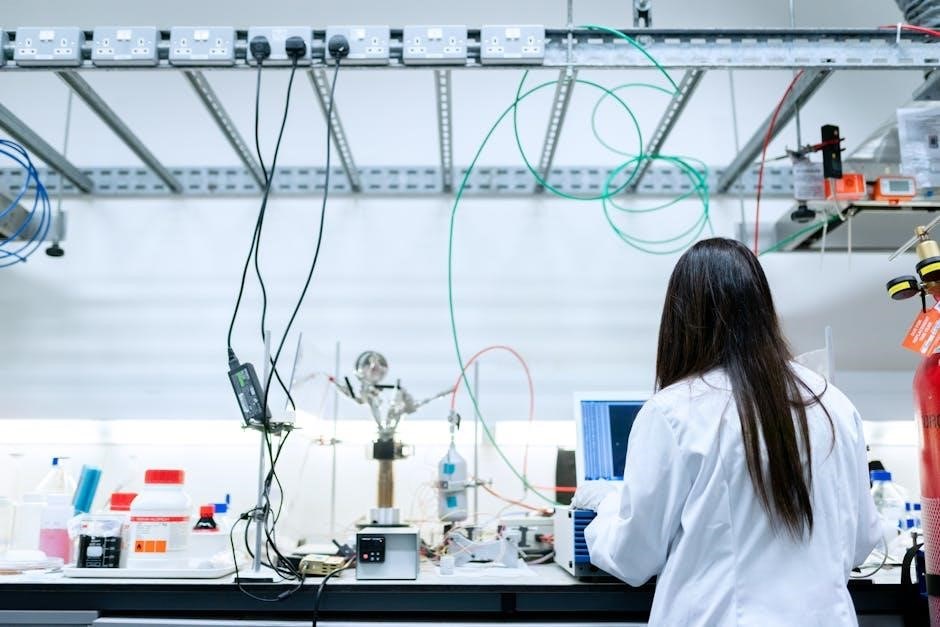
Lab manuals vary by application, encompassing educational guides for students, detailed research manuals for scientists, and specialized versions for clinical or environmental industries.
Educational Lab Manuals (for Students)
Educational lab manuals are specifically designed to support student learning in laboratory settings, providing a structured approach to scientific exploration. These manuals typically include introductory material explaining fundamental concepts, followed by detailed, step-by-step experiment procedures.
A key feature is the emphasis on safety guidelines and protocols, ensuring students understand and adhere to safe laboratory practices. They often incorporate pre-lab questions to assess prior knowledge, data collection sections for recording observations, and post-lab questions to encourage analysis and critical thinking.
These manuals aim to familiarize students with laboratory equipment, techniques, and data analysis methods, fostering a deeper understanding of scientific principles. They bridge the gap between theoretical knowledge and practical application, enabling students to develop essential scientific skills and build confidence in their abilities.
Research Lab Manuals (for Researchers)
Research lab manuals serve as comprehensive guides for researchers, detailing standardized protocols and procedures to ensure consistency and reproducibility in experimental work. Unlike educational manuals, these documents often assume a higher level of prior knowledge and focus on complex methodologies.
They meticulously document experimental setups, data collection techniques, and analytical methods, often including detailed troubleshooting guides and quality control measures. A primary function is to maintain rigorous documentation of all procedures, facilitating peer review and validation of research findings.
These manuals are crucial for training new researchers and ensuring adherence to established protocols within a lab. They also play a vital role in maintaining data integrity and complying with regulatory requirements, supporting the reliability and validity of scientific discoveries.
Industry-Specific Lab Manuals (e.g;, Clinical, Environmental)
Industry-specific lab manuals are tailored guides designed for specialized laboratory settings, such as clinical diagnostics or environmental testing. These manuals go beyond general procedures, incorporating regulations, standards, and best practices unique to each field.
Clinical lab manuals, for example, detail specific protocols for analyzing patient samples, adhering to strict quality control and safety guidelines mandated by regulatory bodies. Environmental lab manuals focus on sample collection, analysis, and reporting procedures compliant with environmental protection standards.
These manuals often include detailed information on instrument calibration, quality assurance, and proficiency testing. They ensure accurate and reliable results, crucial for patient care, environmental monitoring, and regulatory compliance.

Creating and Maintaining a Lab Manual
Lab manual creation demands site-specific customization, annual reviews, and updates reflecting procedural changes, ensuring accessibility for all technicians and documenting inherent risks.
Site-Specific Customization
Adapting a lab manual to the unique environment of a specific laboratory is paramount for its effectiveness and safety. A generic manual, while providing a foundational structure, often lacks the crucial details relevant to the particular equipment, layout, and protocols of an individual lab setting.
This customization involves meticulously detailing the location of safety equipment – fire extinguishers, eyewash stations, and first aid kits – within the lab itself. It also necessitates a comprehensive listing of all equipment available, including model numbers and specific operating procedures unique to those instruments.
Furthermore, site-specific customization extends to incorporating any unique hazards present in the lab, such as specific chemical storage requirements or radiation safety protocols. Tailoring the manual ensures that all personnel are fully aware of the specific risks and safety measures relevant to their work environment, fostering a culture of safety and minimizing the potential for accidents or errors.
Ultimately, a well-customized lab manual becomes an indispensable tool, reflecting the specific realities of the lab and empowering users to conduct experiments safely and efficiently.
Annual Review and Updates
Maintaining the accuracy and relevance of a lab manual requires a commitment to regular review and updates, ideally on an annual basis, or whenever significant procedural changes occur. Scientific advancements, new equipment acquisitions, and evolving safety regulations all necessitate revisions to ensure the manual remains a reliable and trustworthy resource.
The review process should involve input from all lab personnel, fostering a collaborative environment where concerns and suggestions can be openly addressed. Updates should be clearly documented, with version numbers and dates to track changes effectively.
This proactive approach to manual maintenance prevents the dissemination of outdated or inaccurate information, minimizing the risk of errors and promoting consistent, safe practices.
Furthermore, regular updates demonstrate a commitment to quality management and continuous improvement, reinforcing the lab’s dedication to scientific rigor and responsible experimentation. A current lab manual is a living document, adapting to the evolving needs of the laboratory.
Accessibility and Distribution
Ensuring easy access to the lab manual is crucial for its effectiveness. The manual should be readily available to all personnel who require it, regardless of their location within the laboratory or their specific role. Traditionally, paper copies were common, but digital distribution offers significant advantages in terms of accessibility and ease of updating.
A centralized digital repository, such as a shared network drive or a dedicated laboratory information management system (LIMS), allows for instant access to the latest version of the manual.

Consideration should be given to providing access on mobile devices for convenience.
Regardless of the distribution method, it’s vital to implement a system for tracking who has access to the manual and ensuring that all users are aware of its location and how to obtain the most current version. Proper distribution supports consistent adherence to protocols.
The Role of a Lab Manual in Quality Management Systems (QMS)

A lab manual is vital for QMS, documenting procedures, inherent risks, and ensuring consistent safety training for all technicians within the laboratory setting.
Scope of the Quality Manual
The scope of the quality manual, intrinsically linked to the lab manual, meticulously identifies the specific laboratory areas and processes it encompasses. This isn’t merely a listing, but a detailed delineation of all functions subject to the Quality Management System (QMS).
It clarifies which departments, testing methodologies, and analytical procedures fall under the QMS umbrella, ensuring a focused and effective implementation. The lab manual itself becomes a core component within this scope, detailing standardized procedures for technicians.
Essentially, the scope defines the boundaries of quality control, outlining what is – and isn’t – covered by the QMS. This clarity is crucial for maintaining accountability, ensuring consistent results, and facilitating effective audits. It establishes a framework where the lab manual serves as a practical guide, directly supporting the QMS objectives.
Goals and Objectives of Laboratory QMS
The goals and objectives of a Laboratory Quality Management System (QMS) are fundamentally supported by a well-defined lab manual. A primary goal is to ensure the reliability and accuracy of laboratory testing, directly achieved through standardized procedures detailed within the manual.
Objectives include minimizing errors, improving turnaround times, and enhancing overall efficiency – all facilitated by clear, concise instructions for technicians. The lab manual acts as a central repository for these procedures, promoting consistency and reducing variability.

Furthermore, a QMS aims to demonstrate competence and adherence to regulatory requirements, with the lab manual serving as documented evidence of established protocols. Ultimately, the QMS, bolstered by a comprehensive lab manual, strives for continuous improvement in laboratory performance and patient/user safety.
Documentation of Inherent Risks
A crucial function of a comprehensive lab manual within a Quality Management System is the thorough documentation of inherent risks associated with laboratory procedures. This isn’t merely a listing of potential hazards, but a detailed assessment of each risk’s severity and probability.
The lab manual should outline specific mitigation strategies for each identified risk, including safety protocols, equipment safeguards, and emergency procedures. This documentation ensures all technicians are aware of potential dangers and equipped to handle them effectively.
By proactively addressing inherent risks, the lab manual contributes to a safer working environment and minimizes the likelihood of accidents or errors. This detailed risk documentation is vital for regulatory compliance and demonstrates a commitment to responsible laboratory practices, ultimately protecting personnel and data integrity.